Roundtree Developed Her Game At The Park

Staff Writer
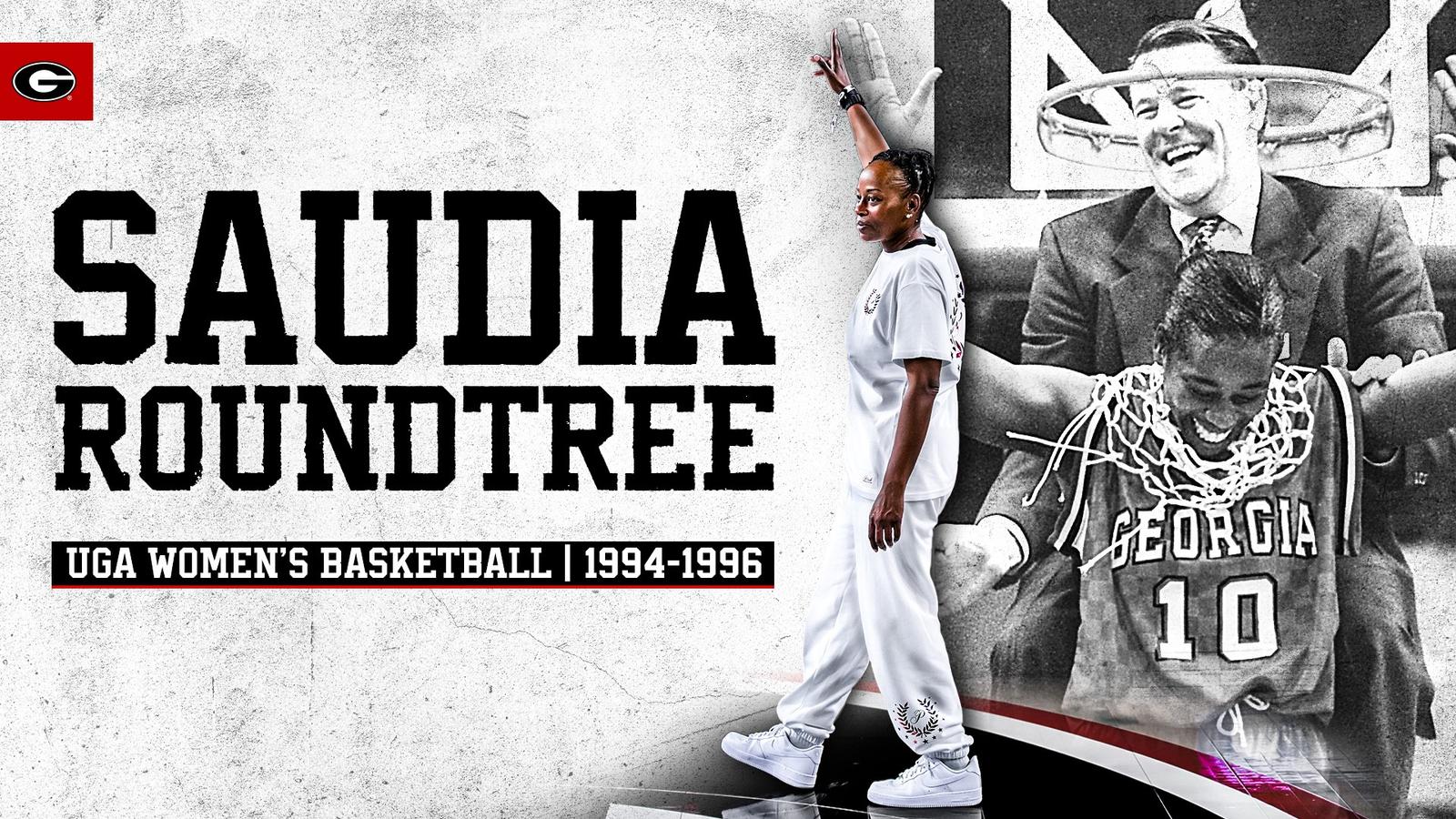
Saudia Roundtree’s game and toughness were sharpened on the public basketball courts in Anderson, S.C. As a teenager, the former Georgia point guard, who in 1996 was the National Player of the Year, spent hours and hours playing pickup games, mostly against bigger and stronger men.
“I just worked and played with the guys every day,” Roundtree said. “I was blessed with God-given talent, but I had to put the work in, and I did that. I had an exceptional work ethic, which I got from my mom, a single parent who’s worked for everything she has.”
The 5-foot-8 Roundtree began her collegiate career at Kilgore Junior College in Kilgore, Texas, where she was the 1994 NJCAA Player of the Year. She then transferred to Georgia and became a Lady Bulldog legend.
“Saudia was unlike any player I ever coached,” said former Georgia coach Andy Landers, who was inducted into the Women’s Basketball Hall of Fame in 2006. “She just had the confidence, the mindset, and the ability to beat you offensively. She always felt like she could score. It didn’t matter the circumstances — man(-to-man defense), zone, good team, bad team — it didn’t matter. She was driven and motivated to do that, to score.”
Landers and Roundtree said a huge part of that mindset came from her time playing against the guys when she was young.
“She developed an uncanny instinct and feel for the game,” said Landers, who won 862 games over his 36 seasons as Georgia’s head coach from 1979-2015. “She polished all of that on the playground, and she learned all that on the playground. She just had a keen sense offensively for how to play, and she was really good.
“Saudia was not only a great player, she played great with her teammates at the same time. And that’s not always the case.”
During the 1994-95 season, her first at Georgia, Roundtree averaged 14.8 points and set a school record with 6.8 assists per game; she also averaged 4.7 rebounds and 1.9 steals. The Lady Bulldogs, who also had standout players like La’Keisha Frett, Tracy Henderson and Kedra Holland-Corn, advanced to the Final Four that season, falling to Tennessee in the semifinals.
The following season, Roundtree was even better, and helped lead Georgia to the No. 1 ranking during the season and one step farther in the NCAA tournament. As a senior, she raised her scoring to 16.7 points per game while also dishing out 5.9 assists, grabbing 5.6 rebounds and getting 2.3 steals.
“That meant everything,” Roundtree said of reaching the Final Four twice. “To be able to play on the biggest stage in college basketball and be one of the top players, that was really special. Those memories you have, you have them forever. But nobody gets anywhere in life by themselves. I’ve been surrounded by good people; God put the right people in my path.”
In the span of 17 days during January that season, Georgia played five straight games against ranked teams and won all five. Among those five were wins over No. 3 Tennessee and No. 3 UConn, which led to the Lady Bulldogs being ranked No. 1 on Jan. 29, 1996, and they stayed there for three weeks.
Georgia returned to the Final Four that season, knocking off No. 1 seed Louisiana Tech in the regional final and No. 2 seed Stanford in the semis, before falling to Tennessee in the championship game. Landers has fond memories from that win, 90-76, over Louisiana Tech.
“Neither one of us could guard each other; it was a race, just up and down. It was going back and forth so much that I sat down, which I almost never did,” he said.
It was the perfect kind of game for Roundtree, who finished with 37 points in 38 minutes and had six assists and four steals. At one point late, Roundtree told Landers during a timeout, “I can take my man anytime I want,” Landers recalled. And she proved that she could, leading Georgia back to the Final Four.
The day before Georgia took on Louisiana Tech, Roundtree, already named the SEC Player of the Year, was announced as the Naismith National Player of the Year, and Landers was National Coach of the Year. Later that year, Roundtree was named the SEC Female Athlete of the Year. She was also honored with the Best Female College Basketball Player ESPY in 1997.
“That meant a lot, just because of the path that I took to get there,” Roundtree said of being named the National Player of the Year. “I had only two years at Georgia to make a name for myself, to prove that I was one of the best players in the country at that time.”
In two seasons at Georgia, Roundtree led the SEC in assists twice. Her 226 assists during the 1994-95 season remain a program record, and her 195 in 1995-96 rank fourth. After college, Roundtree played three seasons in the American Basketball League, which started up around the same time as the WNBA, and she even had her own shoe by Reebok. She later spent several years coaching, including serving as the head coach at North Carolina A&T from 2002-05.
In 2024, Roundtree was presented with the NJCAA Achievement Award, which goes to a former junior college student-athlete who has displayed outstanding ability in national, international or professional competition “while also displaying excellent ethical character,” per the award’s description.
Roundtree was inducted into Georgia’s Circle of Honor in 2012, and later this year, she will be inducted into both the South Carolina Athletic Hall of Fame and the NJCAA Hall of Fame. She was inducted into the Kilgore Athletics Hall of Fame in 2002.
At Westside High School, Roundtree won three state championships. At Georgia, she helped the Lady Bulldogs reach back-to-back Final Fours. Roundtree loved her time playing college basketball, and she’s come back for a lot of Lady Bulldog games this season, but nothing compares to the joy she had playing “street ball.”
“I just love that atmosphere. I would love to come home in the summer and just play,” she said. “I just loved being outdoors, playing in 90-degree weather, and then walking home soaking wet. You just went out and played and had fun.”
All of those days at the park made Roundtree into a mentally and physically tough guard, one who had one of the greatest two-year runs in the history of Georgia basketball.
Assistant Sports Communications Director John Frierson is the staff writer for the UGA Athletic Association and curator of the ITA Men’s Tennis Hall of Fame. You can find his work at: Frierson Files.
Source link
editor's pick
latest video

Sports News To You
Subscribe to receive daily sports scores, hot takes, and breaking news!